Two more ways to shape the harness
1.3 covered the two extension points that live in your project: CLAUDE.md and Skills. The other two reach further. MCP gives the harness tools it doesn't have, and a subagent gives a job its own context window. The table in 1.3 puts all four side by side.
MCP: new tools from outside
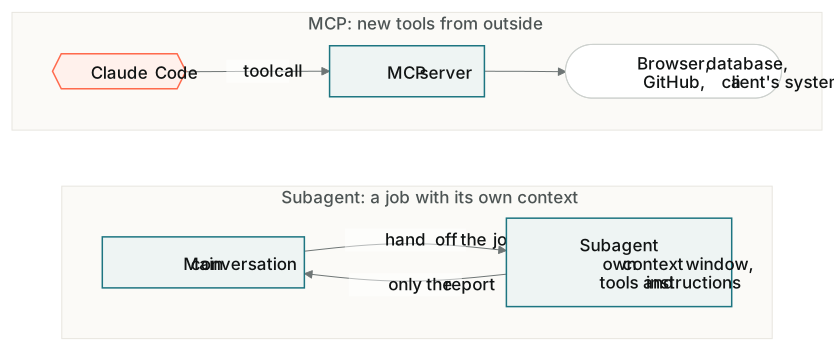
On its own, Claude Code can only touch what's on your laptop. MCP (Model Context Protocol) is the standard plug: someone builds an MCP server for a system (a browser, a database, GitHub, your client's ticketing tool) and Claude Code can call it as a tool. Claude Code asks you to approve each new server. Every server is a new door into a system, so only add the ones you trust.
Subagents: hand off, keep your context clean
A subagent is a specialist Claude can hand a job to, such as "review this whole codebase" or "research ten competitors". It works in its own context window with its own instructions and tools, and only its report comes back. Your main conversation stays short and focused. Book Ch 6 then shows how these pieces combine into pipelines and agent teams, which is exactly where Module 4 picks up.
Skill or subagent?
A rough rule: if the job is a recipe you want done the same way every time, make it a skill. If it's big, separable, or would fill your conversation with noise, give it to a subagent. The Agent Architectures demo under this reading runs one task both ways, side by side.